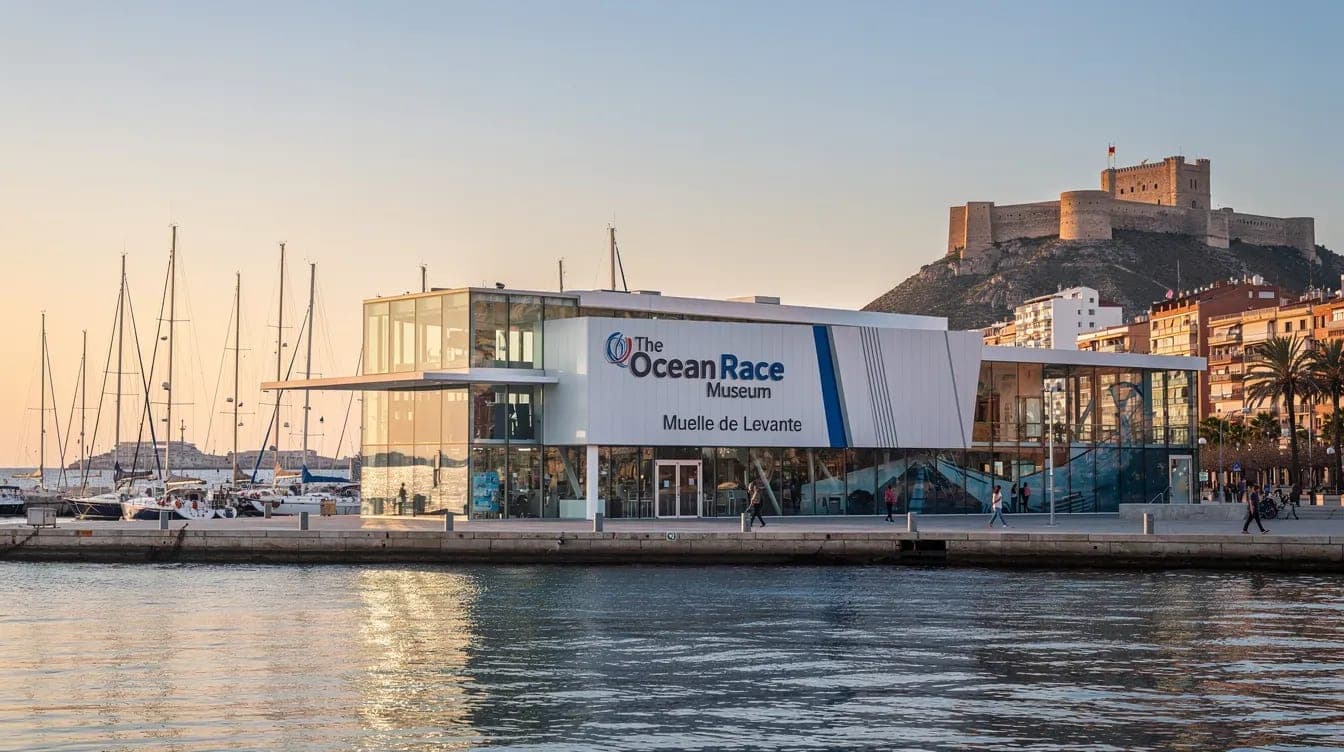
The Ocean Race Museum in Alicante is the only museum in the world dedicated to the toughest round-the-world sailing race on the planet: more than five decades of circumnavigation under sail, first as the Whitbread, then as the Volvo Ocean Race, and today as The Ocean Race. It sits on the Muelle de Levante inside the port, a five-minute walk from the Explanada, general admission and opening hours should be confirmed on the official visit page before you go, and most visitors can tour its interactive rooms in roughly an hour.
This guide answers what people search for before visiting (location, duration, what to see, and where to verify hours or admission) with official sources for the details that change over time.

Last checked and official sources
Last reviewed: 28 June 2026. For volatile details such as opening hours, admission, temporary closures and optional paid experiences, check the Ocean Race Museum official page and its visit information page. For transport, confirm service changes with TRAM Alicante or local bus information before travelling.
Where it is and how to get there: Muelle de Levante 10
The museum occupies a modern building at Muelle de Levante, 10 (03001 Alicante), right by the sea, inside the port complex but with open access from the promenade. The exact address is the same as The Ocean Race's European headquarters, so if you search for ocean race alicante museum on a map, you will see how the whole complex — offices, store, and exhibition area — is concentrated in one place.
How to get there:
- On foot, from the city centre: leave the Explanada de España heading east, cross over by the port, and follow the seafront promenade; it is about 8-10 minutes walking.
- By car: the Panoramis car park and the Volvo Ocean Race underground car park are the closest; traffic inside the port is pedestrian in the museum area.
- By public transport: TRAM Alicante lines L1, L3 and L4 and the city buses stop at Luceros or on the Explanada, a few minutes on foot.
- By boat: if you moor at the Real Club de Regatas de Alicante or at the marina, you are literally next door.
The location has a nice twist: the museum faces the departure dock. The Ocean Race has officially announced Alicante as the start port for 17 January 2027, so the museum is also the best place to understand why the city has been linked to the start since 2008.
Opening hours, admission, and how long the visit takes
Before you go, it is worth confirming hours on the museum's official website, since they change by season and the museum closes on specific public holidays (1 January and 25 December).
Ocean Race Museum opening hours
Opening hours can change by season, holidays and event periods. Use the museum official visit page as the source of truth for the day you plan to go, especially around public holidays, school breaks and The Ocean Race activity in Alicante.
Ocean Race Museum admission
General admission has historically been free, but confirm the current admission conditions on the official visit page before going. Some complementary experiences may require booking or payment, and their availability can change by season. Check the official visit page for the current list, conditions and any age limits before you go.
If you are coming with children aged 6-7 and up, "The Ride" is one of the most memorable experiences: a cabin that simulates the motion of a race boat in the open ocean.
How long to allow
- Quick visit (free exhibition only): 45 minutes.
- Relaxed visit with "The Ride" + Brasil 1: 1 h 30 min – 2 hours.
- Full guided tour: 2 h – 2 h 30 min.
With children between 3 and 10 years old, add a little more because they will want to stop at every interactive screen and model.
What you will see: the 5 spaces of the museum
For anyone searching for what to see ocean race museum, here is the route, split across five main areas. They are not five rooms with separate doors but five connected spaces, each with a different focus.
1. "Navigating history": 50 years of ocean racing
The central exhibition. Curated archive photographs arranged chronologically and by theme, from the first Whitbread Round the World Race in 1973 to the latest edition. There are panels on the legendary skippers, the all-female crews, the Spanish teams, and the toughest editions (1989-90, 2008-09). A great starting point if you do not know the race.
2. Brasil 1: inside a VO70
The star of the museum. Brasil 1 is a Volvo Open 70 that raced the 2005-06 edition with Torben Grael at the helm. Today it sits outdoors next to the museum, and with the Brasil 1 Boat Tour ticket you can step into the cockpit and go down below. You will see the navigation station, the berths (if you can call them that — they are fabric bunks), the spartan galley, and the bench where eleven crew rotated watches for more than 20 days straight. The sense of claustrophobia works as pedagogy: this boat sailed around the world.

3. "The Ride": simulator and virtual reality
The most interactive zone. It includes two paid experiences:
- "The Ride", a moving cabin that simulates the motion of a boat in the Southern Ocean during a race. Seven minutes of adrenaline with immersive audio and front projection.
- 11th Hour Racing Team VR experience, winner of the 2022-23 edition. You put on the VR headset and sail aboard the IMOCA during a manoeuvre.
4. Technology, science, and ocean sustainability
The Ocean Race is one of the few sporting competitions that carries out science during the race: boats fit sensors that gather data on microplastics, CO₂, salinity, and water temperature in ocean zones where no commercial boat sails. This area of the museum showcases the Racing with Purpose programme and its partnerships with bodies like UN Environment and IOC-UNESCO. There are also explanatory models of the foils and the evolution of materials — from aluminium to carbon in 50 years.
5. Temporary exhibition, terrace, and cafeteria with a view
The upper floor alternates temporary exhibitions with a cafeteria and terrace opening onto the whole port. It is the best spot in Alicante for a coffee with views of the start dock and, if the dates line up, of The Ocean Race boats moored below. Events, talks, and nautical presentations are also held here throughout the year.
Bonus outside the museum: if you walk down the promenade toward Plaza Puerta del Mar, you will see the hull of Pirates of the Caribbean, another VO70 from the 2005-06 edition that suffered a major failure. It has been on open display since 2015 and is a free, photogenic stop.
History: from the Whitbread (1973) to the current name
The most-searched H2 after opening hours. Understanding the rebrands is key to not getting lost among the names.
1973 — Whitbread Round the World Race. The race is born. Sponsored by the British brewer Whitbread. 17 boats leave Portsmouth to sail around the world. It establishes itself as a biennial event.
1997 — The Volvo Ocean Race. The Swedish brand takes over as title sponsor. The iconic Volvo Ocean 65 one-design is born, which democratises the competition by putting every boat on equal terms. Many in Alicante and around the world still remember and search for it as volvo ocean race museum alicante: it is the name this race wore during two iconic decades.
2019 — The Ocean Race. After the 2017-18 edition, Volvo steps back as title sponsor and the organisation rebrands the event with a name that underlines its mission: ocean health, sport, and human adventure. The Alicante museum takes on the brand change but preserves the earlier history — which is why its storytelling mixes all three names together.
2023 — The Ocean Race 2022-23. Last completed edition. Won by 11th Hour Racing Team (USA) with the speed of the foiling IMOCAs.
2027 — The Ocean Race 2027. The next round-the-world edition has an official Alicante start date of 17 January 2027, according to The Ocean Race.
Alicante, start port since 2008
Since the 2008-09 edition, Alicante has been the official start port of every round-the-world edition of the race. The city signed a strategic agreement with the organisation and built the current Muelle de Levante complex to host the Race Village, the offices, and the museum.
Why Alicante? Three reasons the museum explains well:
- Predictable sea and wind conditions in mid-January, without the harsh lows seen in northern Europe.
- Port infrastructure with enough draft for the IMOCAs and VO65s, technical berths, and neighbouring shipyards.
- Institutional commitment from the City Council, regional institutions and the Port Authority, with Alicante continuing as the confirmed 2027 start port.
In the months before each start, public programming is announced by the race and local institutions. If you visit the museum in a race year, check The Ocean Race official channels for Race Village, fan-zone or dock-access details before relying on older editions.
How to round off your visit around the port
The paradox of the museum: you leave with your head full of the sea, but the actual sea is 50 metres away. If you have time after the visit, the neutral continuation is to walk the port, look across the start dock and compare the exhibition with the real harbour geography outside.

If you want more local context after the museum, read the one-day boat trip to Tabarca Island guide, the best time to rent a boat in Alicante and the anchorages and coves in Alicante guide. Those are related reading links, not part of the museum visit itself.
From land, the museum explains 50 years of racing. From the port, you can see why Alicante became such a visible start city.
For any separate nautical activity after the museum, check weather, sea state and operator conditions independently.
Verification notes
Last reviewed: 28 June 2026. Event claims in this guide should be checked against The Ocean Race official 2027 start announcement and the Alicante city page on The Ocean Race 2027. For any weather-dependent port walk or separate sailing plan, use AEMET and Puertos del Estado PORTUS close to the date.